
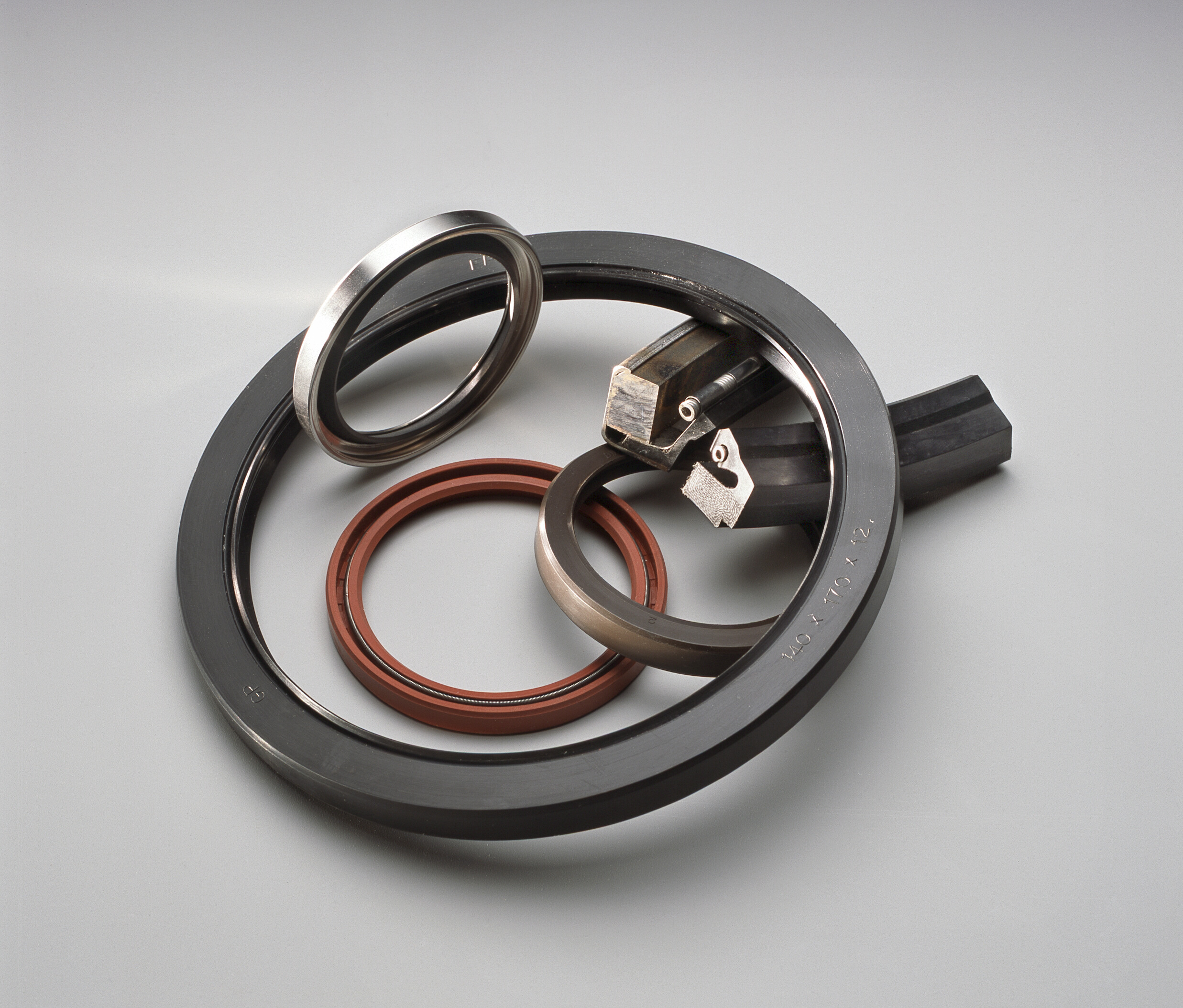
Shaft Seals
Shaft seals, or oil seals, play a crucial role in the performance and longevity of industrial machinery. They prevent fluids from leaking out of equipment, reducing downtime and extending the lifespan of critical components.
What are shaft seals?
Shaft seals, also known as oil seals, are devices that prevent fluids from leaking out of machinery. They're typically made from a rubber or plastic material and are designed to fit around the shaft to create a barrier that keeps oil, grease and other fluids contained.
Shaft seals work by creating a fluid film barrier between the sealing lip and the rotating shaft; the addition of a wiper lip also helps to keep out the general environment. The shaft seals outer casing diameter is sealed via its interference fit in the recess within the machinery it operates.
Why are shaft seals important?
Shaft seals play a critical role in the effective operation and maintenance of industrial machinery. They are designed to prevent fluids, such as oil, grease and other lubricants, from leaking out of equipment and causing damage to critical components. Benefits of shaft seals include:
- Preventing Leaks: Shaft seals create a barrier that prevents fluids from leaking out of machinery. This is especially important for equipment that operates in harsh or hazardous environments where leaks can cause damage, create safety hazards or contaminate the surrounding area.
- Reducing Downtime: When equipment experiences fluid leaks, it often requires maintenance or repairs to fix the issue. This downtime can be costly in terms of lost productivity and revenue. Shaft seals help minimise the risk of leaks, reducing the likelihood of unexpected downtime.
- Extending Lifespan: When fluids leak out of machinery, they can cause damage to internal components, leading to premature wear and tear. By preventing leaks, shaft seals help extend the lifespan of industrial equipment, reducing the need for costly replacements or repairs.
Profiles and types of shaft seals
There are several types of shaft seals, including:
Lip Seals: The most common type of shaft seal is the lip seal. Lip seals consist of a flexible lip that seals around the shaft to prevent fluid leakage. The lip is typically made from a rubber or plastic material that is designed to be in contact with the shaft without causing excessive wear.
Labyrinth Seals: Labyrinth seals are more complex than lip seals and consist of multiple grooves or chambers that fluids must pass through to escape. The grooves or chambers are designed to trap the fluid and prevent it from leaking out of the machinery.
Mechanical Seals: An advanced type of shaft seal that consists of two flat surfaces that are pressed together to create a seal. They are commonly used in high-pressure and high-temperature applications where lip seals and labyrinth seals may not be effective.
Profile
Type
Description

Type A+AI. Type A shaft seal is a standard type according to DIN3760. It is equipped with a rubber coating on the outside, which ensures a good seal in the housing. Type A can be supplied with hydrodynamic helix-ribs on the lip for back-pumping of any leaked oil. It is particularly recommended for applications that suffer from high eccentricity or vibrations and can be designed for bi-directional or specific direction operation.
Type AI shaft seal, on the other hand, is available in metric and inch sizes, and features an additional interference fit. This helps to enhance the seal's effectiveness and reduce the risk of leakage. Type AI is also suitable for use in high-pressure applications and is capable of handling a range of fluids, including aggressive media.
Delivered on request.
Type AT Type AT is a specialised shaft seal that has been designed to perform optimally under high pressure (0,5-10 bar) and speed conditions. Its durable elastomer lip seal, which is spring-loaded and housed within a metal casing, provides a secure and effective seal against the shaft. The self-supporting lip ensures a reliable fit, while the secondary dust lip prevents the ingress of contaminants. It is important to note that to ensure maximum sealing efficiency, it is recommended to secure the seal in the borehole with a locking ring or flange. However, it should be noted that this seal is not well-suited for handling eccentricity and whipping due to its rigid and short lip design. Type AT is commonly used in a variety of industries, such as automotive, aerospace, and heavy machinery.
Type AG Type AG is a type of shaft seal that is commonly used in food and pharmaceutical industries. It is designed to provide a high level of hygiene and can be easily cleaned. Type AG features a stainless steel casing with a lip seal made of FDA-approved elastomer material, ensuring it it is safe for use with food and pharmaceutical products. It also has a secondary dust lip to prevent contaminants from entering the housing. Type AG is typically used in applications with low to medium speeds and pressures.
Note: Requires special tools.
Type ATS Type ATS is a high-performance shaft seal designed to withstand extreme conditions such as high temperatures and high speeds. It features a metal casing with a spring-loaded lip seal made of advanced materials such as PTFE or FKM, which provides superior resistance to wear, corrosion and chemicals. Type ATS is also equipped with a secondary dust lip to prevent contaminants from entering the housing.
This type can be supplied in 110 standard sizes, or in other sizes upon request.

Type AX+AXI Like type A/AS, but the outer circumference is corrugated. This design facilitates the installation of the seal and allows for a closer fit. This can ensure better static sealing - especially where the housing is subject to high thermal expansion. 
Type AUF Type AUF is a type of seal that is designed without any spring loading mechanism. It is typically utilised in narrow constructions, especially in sealing needle bearings. The primary purpose of this type of seal is to prevent the entry of dust or grease into the bearings, thereby ensuring their proper functioning. 
Type AS+ASI Type AS and Type ASI are similar to type A, but with an additional dust lip. The dust lip protects the shaft and main sealing lip under certain service conditions where the oil seal is exposed to dust or dirt, e.g. high pressure cleaning. But in some applications, it might accumulate dirt between the two lips, and score the shaft more rapidly than with a type A seal without the dust lip. 
Type B+BI Type B and Type BI is without rubber covering on the outside. Used under conditions where maximum heat transfer to the housing is desired. Compared to type A, this seal demands a better finish of the housing bore in order to secure a proper secondary sealing, but on the other hand, a better fastening can be achieved eventually by gluing.

Type BS+BSI Like type B, but with additional dust lip in both metric inch sizes (BSI).

Type BP Oil seal with housing in stainless steel (std DIN1.4301) and with sealing lip of PTFE. The characteristics of this seal are very low friction and very good resistance to high temperature and chemical attacks. Can be specified for speeds up to 30 m/sec., and for a certain degree of dry-running. Due to its low friction, the BP seal can be used at pressures up to 10 bar (20 bar in special design) considering the speed. Low breakaway force after long time of standing still. The only oil seal that can work in the temperature range between -60 to +220°C (-76 to 428°F). ). It is stocked by M Seals in standard sizes.

Type BUF Like AUF, but without the rubber covering 
Type ADUO Can be used where two fluids have to be separated. Supplied in certain sizes or as per request 
Type C+CI Like type B, but with reinforced housing (double shell). Used where a higher grade of stiffness is desirable, e.g. large dimensions where there is a risk of distorting the ring during the fitting. Thinner inner housing also protects the lip from mechanical impact, e.g. in mill machinery, earth moving equipment and the like. Supplied in standard dimensions in metric and inch sizes (CI). 
Type AE For external sealing. Used where the housing rotates in relation to a non-rotating shaft, or for relative movement between shaft and housing. If a standard type is used in such applications, the sealing lip will lose its radial force against the shaft due to the centrifugal force. Supplied on request. 
Type CS+CI Like type C+CI, but with additional dust lip. Heavy duty shaft seals
M Seals' heavy duty shaft seals are particularly suitable for large diameters and aggressive applications such as rolling mills, wind turbines, pulp and paper industry, gearboxes and other demanding applications where high speed and large displacement are found in difficult environments.

The DR10 range is constructed with a flexible textile reinforced rubber structure that allows easy fitting, and with a garter spring. Also available in a split form for re-fitting in place, without removing the shaft.
This type normally requires a retaining cover. Can also be supplied with additional dust lip and different types of lubricating grooves (where the seals are used
back-to-back or in tandem).
The DR20 is a rubber seal with finger spring. In split form, this seal type is suited for difficult fitting conditions, and in endless form it is also suited as a wiper ring in hydraulic applications. 
The A10 is a rubber seal with garter spring, with a stiffening steel reinforcement. It has good flexibility for easy installation, which in some cases allows use without a retaining cover. A variation for use in very narrow cross sections is type A20. The steel reinforcement can then prevent the seal from tilting in the groove, and the spring is the finger type for secure installation and even radial force. 
The C10 range is built with a strong steel casing and with a finger leaf + garter spring, making this type of seal especially suited for large misalignments (shaft deflection, large bearing clearances etc.). This type is also capable of shaft speeds up to 35m/sec. and is widely used in rolling and is paper mills.
Choosing the right shaft sealWhen selecting a shaft seal, consider the following factors:
Material: Shaft seals are available in a range of materials, including rubber, plastic and metal. Consider the operating environment, fluid compatibility and temperature range when selecting the right material for your application.
Size: Shaft seals come in a variety of sizes to fit different shaft diameters. Make sure to select the right size to ensure the correct fit for optimal sealing performance.
Design: Shaft seals come in different designs, including lip seals, labyrinth seals and mechanical seals. Consider the specific application and operating conditions when selecting the right design for your equipment.
Eccentricity in shaft seals
It is naturally desirable for efficient sealing that the shaft should run true, but in practice, a certain amount of eccentricity has to be accepted. Oil seals are designed so they can follow the movement of the shaft within certain limits by its flexible resilient lip.