O-Rings
O-rings are known for their effectiveness, affordability and reliability. We specialise in providing both standard and customised sealing solutions that meet all types of requirements, whether they are for static or dynamic purposes.
Types of O-Rings
We offer a wide range of seals in various materials and sizes:
- Nitrile o-rings
- Viton™ o-rings
- EPDM o-rings
- Kalrez® o-rings
- FFKM o-rings
- HNBR o-rings
- PTFE o-rings
We keep stock of over 80,000 o-rings across 10,000 individual sizes to suit both large and small enquiries.
O-Ring Dimensions
Our O‑rings come in a wide range of dimensions to suit everything from tiny precision instruments to heavy‑duty industrial equipment. We supply both imperial and metric sizes, to help ensure compatibility across global applications.
Stock Agreements
If your company has a regular need for a certain quantity of seals, you can enter into a stock agreement with M Seals. This ensures that a minimum stock is always available, providing you with supply security for critical productions or urgent tasks.
Custom O-Rings
In addition to our standard seals, we specialise in custom manufactured sealing solutions, designed to meet unique requirements with specific dimensions, including spring energised seals and other advanced solutions that are ideal for complex applications. We develop innovative sealing solutions that ensure optimal performance and reliability in any situation.
M Seals is equipped with CNC machines in-house, allowing for the bespoke design and rapid production of customised seals. We provide same-day dispatch for our engineered seals as well as all stock items, guaranteeing that each product meets rigorous quality standards and arrives on time.
O-Ring FAQs
O-Ring Sizing & Standards
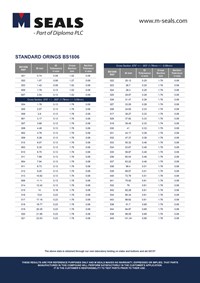
To identify the right O ring size, measure the following key dimensions: Inside Diameter (ID), Outside Diameter (OD) and Cross Section (CS). Then refer to our BS O ring size guide to find the correct standard size. If your o-ring is not a standard size, we can produce custom o-rings – contact us for technical support.
No. An o-ring’s performance relies on a perfect fit within the groove. An incorrect fit, whether too big or too small will not create a tight seal and may lead to extrusion or leakage.
Different countries use a different standard of measurement, so in global supply chains, it is important to know the correct size for the application. Metric O-rings are measured in millimetres (mm) and often follow standards DIN 3771 or ISO 3601. Imperial O-rings are measured in inches (in) and follow American standards, most commonly AS568.
Materials & Performance
Material selection depends on the application, taking into account chemical compatibility, operating temperature, sealing pressure, environmental conditions etc. Common materials for o-rings include Nitrile (NBR), Viton™ (FKM), EPDM, Kalrez® /FFKM, HNBR, Silicone and PTFE. If you need advice on the best o-ring material for your application, please refer to our material data sheets or contact us.
The temperature an o-ring can withstand depends on the material it is manufactured from. For each material, the upper and lower limits are dependent on the specific material grade. As a guide:
- Nitrile: up to ~100°C
- Viton® (FKM): up to ~200°C
- EPDM: up to ~150°C
- Kalrez: up to ~325°C
- HNBR: up to ~150°C
- Silicone: up to ~200°C
- PTFE: up to ~300°C For advice on the best material for high temperature applications, please contact us.
Standard O-rings typically hold up to 1,500 psi, but using specialised materials and back-up rings, they may be able to handle pressures exceeding 10,000 psi.
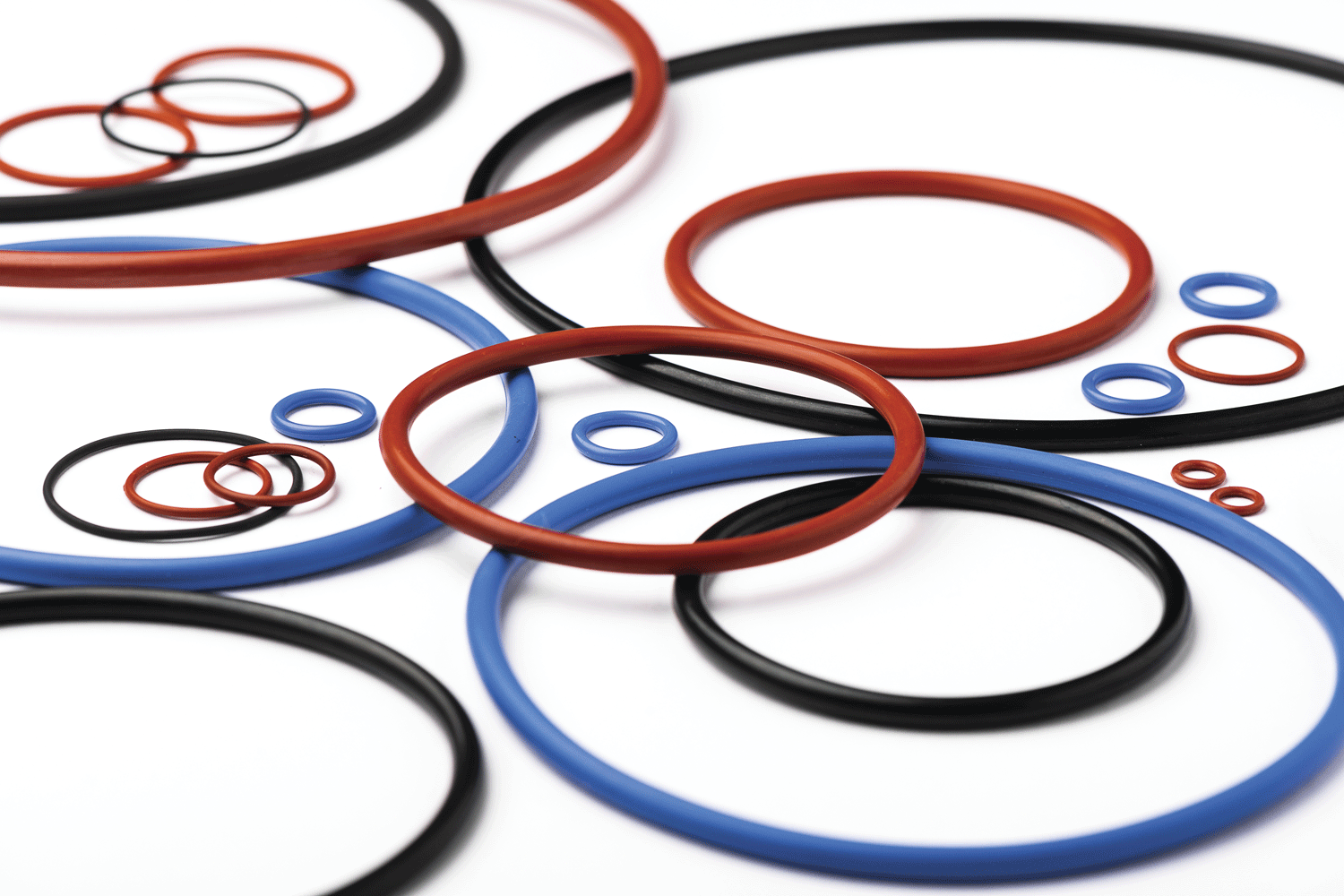
Yes, the colour of an o-ring often identifies the material compound, its durometer, temperature and chemical resistance. Whilst there is not a universal standard, common o-ring colours are:
- Black - NBR/Buna-N or EPDM
- Green - Viton/FKM or HNBR
- Brown - Viton/FKM
- Blue - Fluorosilicone/Metal Detectable
- White/Transparent - Silicone or PTFE
- Yellow - PTFE
- Purple - FFKM
Design, Selection & Application
The ideal durometer for an O-ring depends on factors such as system pressure, installation constraints and the amount of movement within the application. In most general purpose situations, both static and dynamic, a 70 Shore A O ring provides the best balance of flexibility and durability. For low pressure systems or applications involving delicate components, a softer compound in the 40–60 Shore A range is usually more appropriate. On the other hand, high pressure, high temperature, or extrusion prone environments require a harder material, making a 90 Shore A durometer the preferred choice. If you are unsure, we can advise on the best durometer for your needs.
Yes. We can supply o-rings in a range of materials compliant for food or medical applications, including EPDM, Silicone (VMQ), FKM (Viton®), NBR, PTFE and Metal Detectable.
Yes, lubrication (using grease or oil) is necessary to reduce friction which prevents damage to the O-ring during installation and use. It also helps to create a tighter seal. You can apply lubricant to the seal using your fingers or a brush, or you can dip the O-ring into a container of lubricant. Be sure to fully cover the O-ring for proper lubrication.
Installation, Maintenance & Lifespan
The most common causes of O-ring failure are abrasion, caused by rough or improper finishing of the contact surface, compression set, chemical incompatibility, wrong material choice or improper installation. Choosing the right material and proper installation greatly extends service life. If you need our assistance with this, please contact us.
Although it is dependent on environment and material, the average shelf-life ranges from 5 to 20 years if stored correctly.
Storage conditions can affect the shelf life of o-rings so they should be stored in a cool, dry place, avoiding exposure to UV light, moisture and ozone. Store them away from direct heat sources, electric motors, or contaminants like solvents and oils.
O-ring maintenance schedules vary significantly depending on application, environment and material. Seals should be included in your scheduled equipment service, whatever that may be for your industry or application.
It is time to replace seals when you notice visual signs like cracks, nicks or hardening, or if there is leakage.
Custom Solutions
Yes. In addition to standard seals, we specialise in custom manufactured sealing solutions, designed to meet unique requirements for complex applications. We design and manufacture in-house, so have complete control over the process.
Ordering & Delivery
Please contact our sales team using the 'Request a Quote' form above.
For stock items, we will ship them same day for next day delivery. For non-stock items, we are committed to obtaining them promptly, ensuring the shortest possible lead times.