CASE STUDY | OIL & GAS
Seals for Protection Sleeve
An engineering firm in Aberdeen, known for their problem-solving capabilities, reached out to us. They needed to create a sleeve to seal a 20-inch pipe for a high-profile customer. This customer had previously tried to address the issue unsuccessfully and had turned to our customer for a solution.
AssessmentThe pipes that required sealing had not undergone any machining, leaving them with rough surfaces that might have also been coated with residual paint and other contaminants. Moreover, the pipe ends lacked a lead-in chamfer, which made the installation of the sleeve along with its seals notably difficult, bordering on impossible.
The exact diameter of the pipe could fluctuate slightly, which meant that the sleeve had to be manufactured with enough clearance to address this issue. This resulted in an extrusion gap larger than what was acceptable for sealing. In the worst-case scenario, we were sealing at 100 bar (1450 psi). Additionally, the client required a turnaround of one week. We needed to design, source materials, manufacture, and deliver the seals within five business days.
Solution
It was agreed with the customer that external sealing of the pipe was preferable because of the absent lead-in chamfer. Therefore, we incorporated the chamfer into the sleeve’s design, allowing it to fit onto the pipe’s outside rather than inside.
We selected our HNBR-B85, a peroxide-cured hydrogenated acrylonitrile butadiene rubber, to seal the drilling fluid because of its resistance to the chemicals present in various grades of this fluid.
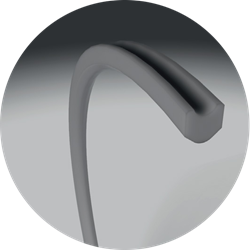
Due to the un-machined surface with poor finish, a seal with a substantial cross-section for better compression was chosen. We opted for a customised SB35 profile featuring a larger cross-section and a deeper external groove to facilitate easier compression and effective sealing against the pipe’s irregular surface.
Result
The design of the seals was completed, and the production and dispatch of the seals occurred within the planned schedule. The client successfully fitted and tested these seals, following which the sleeve was sent off to their customer.